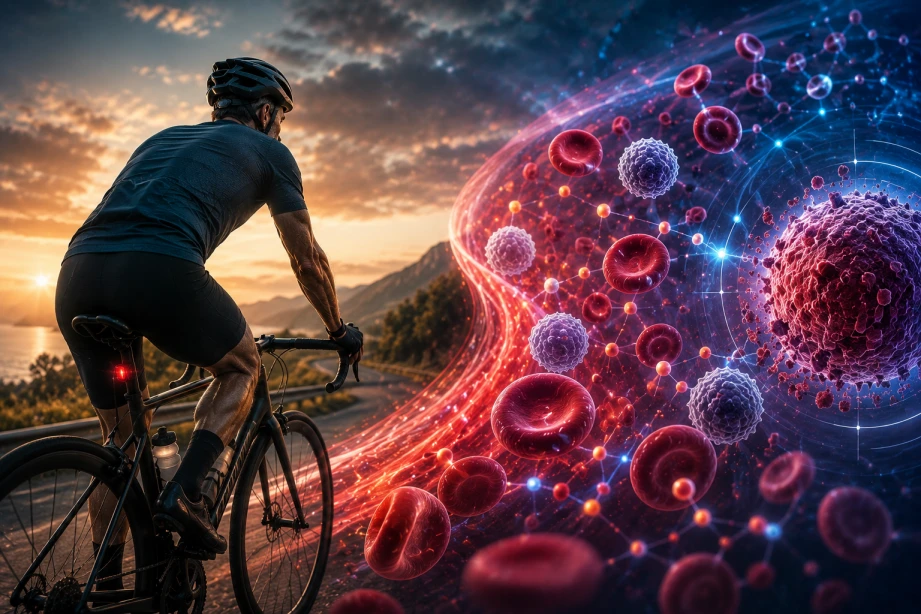
If you have been diagnosed with prostate cancer, someone has told you to exercise. That advice is everywhere.
Exercise helps your heart, your muscles, and your mood.
But there’s another reason exercise belongs in every prostate cancer conversation: it changes what’s happening inside your blood. And according to one study out of Sweden, those changes make your body a much harder place for prostate cancer to survive in.
That study looked inside men’s bloodstream.
Researchers at the Karolinska Institute wanted to answer a simple question: Regular exercise was already linked to a lower risk of aggressive prostate cancer, but nobody knew what happened in the body immediately after a single workout.
Some scientists were actually worried about the answer. Exercise temporarily raises several hormones and growth signals that help your muscles recover. Since prostate cancer cells also respond to these growth signals, researchers wanted to know: could a workout briefly hand cancer an advantage?
They recruited 10 healthy men. Each one cycled for 1 hour at a moderate-to-high intensity. Blood was drawn twice: immediately before the workout, and again two hours after it ended.
Next, researchers took prostate cancer cells growing in the lab and exposed one batch to the pre-workout blood, and another batch to the post-workout blood.
What changed after a single workout?
Surpisingly, the prostate cancer cells exposed to post-workout blood grew 31% more slowly (!) over the next four days. That’s MASSIVE!!
These men didn’t change their diet, lose weight, or train for weeks. They rode a bike for one hour.
That’s it.
Two hours later, their blood had changed enough to slow prostate cancer cell growth in a lab dish. Their own blood became a therapy against prostate cancer.
What actually changed in the blood?
Researchers measured 42 different molecules, but two changes stood out.
The first was a protein called IGFBP-1, which increased 4.6 times after exercise. Its job is to grab onto a growth hormone called IGF-1 and pull it out of circulation. Prostate cancer cells use IGF-1 as fuel to grow and divide, so the more IGFBP-1 in your blood, the less growth signal goes to the cancer.
The second was a 43% drop in EGF (epidermal growth factor), another signal that tells cells to multiply. Less EGF means fewer messages reaching prostate cancer cells telling them to keep dividing.
What happened when the cells were placed in mice
Researchers didn’t stop at the lab dish. They actually went ahead and implanted the same prostate cancer cells into mice. The cells that had first been exposed to post-workout blood formed tumors much later than the cells exposed to pre-workout blood.
The ground had changed. And it made an impact on the cancer itself, even inside a living organism.
What does this mean if you have prostate cancer?
Every workout is doing far more than burning calories. It’s changing your growth signals, your inflammatory markers, and your hormones, all at once. And according to this study, that shift makes your blood a less welcoming place for prostate cancer cells.
Could a single hour on a bike really matter that much?
Apparently, yes.
This helps explain why exercise keeps showing up as one of the strongest lifestyle interventions available to men living with prostate cancer.
One workout is good. But consistency is where the real payoff lives.
This study captured only a single workout! Imagine what it will do to your internal environment after repeated exposure, with each session building on the last.
One workout will not cure prostate cancer. But repeated, consistently, it becomes medicine.
If one hour of cycling changes the bloodstream enough to slow prostate cancer cell growth, think about the effect of stacking exercise with everything else that shapes your internal environment: nutrition, sleep, body composition, inflammation, stress, and recovery.
What if you started treating exercise like medicine, starting with your very next workout?
That’s where lifestyle stops being a vague idea of “staying healthy” and becomes a real strategy, turning hostile ground into a powerful weapon against prostate cancer.
Ready to make your next workout count? Grab more free, evidence-based strategies in my newsletter. If you want accountability and a community of men doing this together, my Prostate Cancer Health Coaching Group is where to go. And if you want a plan mapped directly to your diagnosis, treatments, fitness level, and medical history, that’s what my 1-to-1 coaching is built for (and also includes the group).
Other articles you may find interesting

What happened in the brain after three months of tomato paste?
I regularly recommend tomato paste to men with prostate cancer. A new human study gives us something else to talk about.
How prostate cancer rewires itself when testosterone is cut off
A hidden metabolic switch may change how castrate-resistant prostate cancer survives hormone therapy through diet.
What Happens to Prostate Cancer When Tomato Is Added to a Western Diet?
The same food was tested under two dietary conditions. What happened challenges the way we think about “anticancer” foods.
The pill that’s cutting prostate cancer deaths by 41%
New research suggests a widely used medication may reduce the risk of prostate cancer coming back after surgery, especially in aggressive disease.
References
Rundqvist, H., Augsten, M., Strömberg, A., Rullman, E., Mijwel, S., Kharaziha, P., Panaretakis, T., Gustafsson, T., & Östman, A. (2013). Effect of acute exercise on prostate cancer cell growth. PLoS ONE, 8(7), e67579.