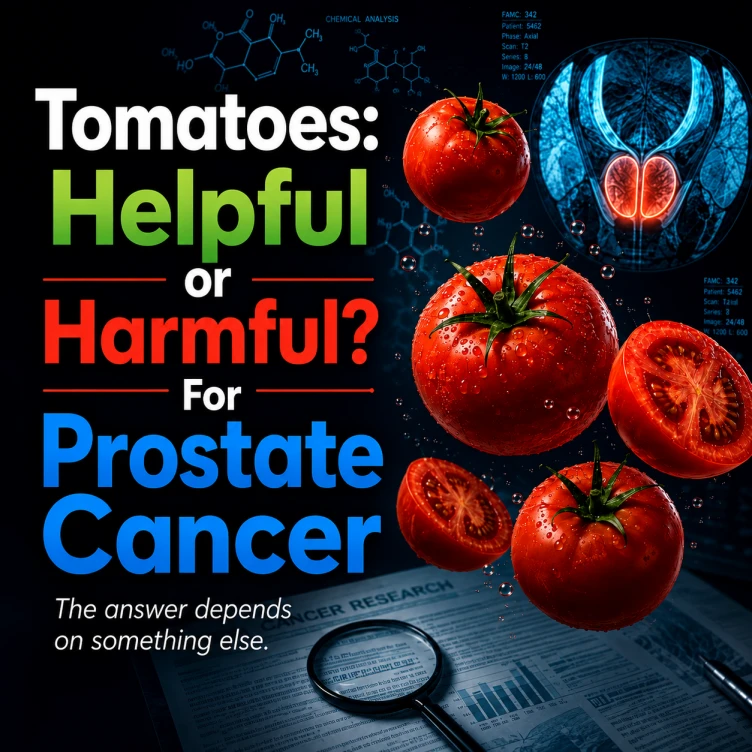
You have probably heard me talk about tomatoes before.
Tomatoes are rich in lycopene and other carotenoids, which are highly studied dietary compounds in prostate cancer. Tomato paste, tomato sauce, cooked tomatoes, and other concentrated tomato products can provide particularly high amounts.
So, understandably, many men with prostate cancer start eating more tomatoes. More tomato sauce. More tomato paste.
And there is good reason to be interested in them.
But researchers conducted an experiment that raises a much bigger question:
Does the rest of your diet change what tomatoes actually do to prostate cancer?
They took mice genetically programmed to develop aggressive prostate cancer and divided them into four groups.
The mice ate:
A control diet
The control diet + tomato powder
A high fat, high sugar Western style diet
The Western style diet + tomato powder
There were only five mice in each group, which is important. This was a small animal experiment. You cannot take the percentages you are about to see and assume that the same thing would happen inside a man with prostate cancer.
But what happened was fascinating.
First, how much tomato were they actually eating?
The amount of tomato used in the experiment was equivalent to roughly ½ cup, or 123 grams, of tomato sauce per day for a 157 lb (71 kg) man. That would provide approximately 17 milligrams of lycopene per day. So we are not talking about some ridiculous dose that would require eating kilograms of tomatoes every day. It was an amount that can realistically be achieved through food, and in fact, with the men I work with, I make sure they get double that amount through their diet.
Then the researchers looked at what happened to the prostate tumors.
On one diet, tomato appeared to strongly suppress tumor growth
When tomato was added to the control diet, the results looked very encouraging.
After researchers adjusted tumor size for the body weight of the mice, the mice eating tomato had tumors that were 29% smaller when the tumors were detected. And by the end of the experiment, their adjusted tumor weight was 32% lower.
That is probably the result most people would expect after hearing about the potential anticancer effects of tomatoes and lycopene.
But then you look at what happened in the other group… and this is where the study becomes much more interesting.
The exact same tomato produced a completely different result
When tomato was added to the Western-style diet, the results went in the opposite direction.
Adjusted tumor volume was 382% greater. That means the tumors were approximately 4.8 times larger.
What???
The tomato intervention associated with smaller tumors on the control diet was associated with much larger tumors when placed inside a high-fat, high-sugar Western dietary pattern.
That does not mean tomatoes cause prostate cancer to grow if you occasionally eat some junk food. It also does not mean men with prostate cancer should stop eating tomatoes. But it suggests something extremely important about nutrition that gets ignored all the time…
Foods do not exist inside your body in isolation
We love searching for individual “anticancer foods.”
Tomatoes. Broccoli. Green tea. Pomegranate. Turmeric.
And then we ask:
“Does this food fight cancer?”
But your tumor does not experience a spoonful of tomato paste sitting inside a laboratory dish.
It experiences the entire metabolic environment you create every day.
Your blood glucose.
Your insulin. Your body fat. Your inflammatory environment. Your hormones. Your circulating fatty acids. And thousands of nutrients and compounds entering your bloodstream from the rest of your diet.
This experiment gives us a very interesting example of how dramatically that environment may matter… Because something else happened in these mice that makes the findings even stranger.
The tomato was still affecting the tumor
Researchers measured tumor blood perfusion, essentially the blood flow supplying the tumor.
Cancer needs a blood supply.
As tumors grow, they stimulate the formation of new blood vessels through a process called angiogenesis.
Tomato strongly reduced tumor blood perfusion under both dietary conditions.
On the control diet, blood perfusion fell by 17.6 percentage points with tomato. And on the Western diet, blood perfusion fell by 16.6 percentage points with tomato.
Strangely similar, isn’t it?
The researchers also found reductions in vascular endothelial growth factor (VEGF), a major signaling protein involved in the formation of new blood vessels.
So the tomato was still exerting biological effects inside the tumor.
It was suppressing aspects of the tumor’s blood supply.
Yet the tumors growing within the Western dietary environment still became dramatically larger.
And the differences went even deeper
The researchers also examined molecular signaling inside the tumors.
With the control diet, tomato reduced several signals associated with inflammation and androgen activity.
Remember that androgen signaling is particularly important in prostate cancer because androgens such as testosterone can stimulate prostate cancer cells through the androgen receptor.
But several of those favorable molecular responses changed or reversed when tomato was combined with the Western diet.
So this study gives us some pre-clinical direction -> The biological effect of a food may depend partly on the dietary and metabolic environment surrounding it.
Do we see anything similar in men?
We obviously cannot deliberately place men with prostate cancer on terrible diets and wait to see whether they die from their cancer.
But we do have observational research.
One study followed 926 men with nonmetastatic prostate cancer and looked at their dietary patterns after diagnosis.
The researchers compared men eating the strongest Western dietary pattern with those eating the least.
The Western pattern was characterized by foods such as processed and red meats, high fat dairy products, refined grains and other foods typical of a Western diet.
The result?
Men eating the strongest Western dietary pattern had a 153% higher risk of dying from prostate cancer. They also had a 67% higher risk of dying from any cause.
Now, this was observational research. It cannot prove that the Western diet itself caused those deaths.
Men who eat poorly may differ from men eating healthier diets in many other ways.
But when you place this alongside mechanistic studies, animal research and the broader literature linking metabolic health with prostate cancer outcomes, the overall dietary pattern becomes increasingly difficult to ignore.
So should you still eat tomatoes?
Yes.
I regularly recommend cooked and concentrated tomato products as part of a prostate cancer nutrition strategy.
Tomato paste, passata, tomato sauce and cooked tomatoes can provide large amounts of lycopene and other potentially beneficial compounds.
But there is a mistake I want you to avoid:
Do not use tomato sauce as nutritional damage control.
You cannot assume that adding tomato paste to a poor dietary pattern somehow cancels everything else out. They are not magic.
Eating anti-prostate cancer foods while eating a diet dominated by refined carbohydrates, excessive calories, processed meats, ultra-processed foods, and very little plant food is not the nutritional strategy I would build for a man trying to give himself the best possible environment during prostate cancer treatment.
Use tomatoes as one component of the overall diet.
Build that diet primarily around vegetables, legumes, whole grains, herbs and spices, while including appropriate high-quality protein sources for your individual situation.
And if you are receiving androgen deprivation therapy (ADT), your overall metabolic health becomes especially important. ADT can promote increased body fat, reduced muscle mass, insulin resistance and unfavorable changes in blood lipids.
Exercise, maintaining muscle, controlling excess body fat and eating an appropriate diet should therefore receive serious attention alongside your cancer treatment.
There is one important exception.
If you have advanced cancer, are undergoing chemotherapy, have lost substantial body weight, have poor appetite or are struggling to maintain muscle, preventing malnutrition takes priority.
That is a different situation.
You may need a substantially more calorie-dense diet while making sure you are consuming enough protein and energy to maintain your body weight and muscle.
The bigger lesson from this study
There will probably never be one food that determines what happens to your prostate cancer.
Nutrition is more complicated than that.
Tomatoes may influence angiogenesis, inflammatory signaling, androgen pathways, and other biological processes relevant to prostate cancer.
But what this experiment beautifully demonstrates is that the surrounding dietary environment can completely change the outcome.
So eat the tomatoes. Cook them. Use tomato paste. Use tomato sauce. Get your lycopene.
But pay attention to what is sitting next to them on your plate.
If you want evidence-based nutrition and lifestyle strategies for prostate cancer, subscribe to my newsletter for practical weekly guidance.
If you want a plan built around your PSA history, treatment, medications, diet, exercise and individual goals, my 1-to-1 coaching can help you build a strategy specific to your situation.
You can also join my Prostate Cancer Health Coaching Group, where men use exercise, nutrition, and lifestyle as medicine while supporting each other through every stage of the journey.
Other articles you may find interesting
What happened in the brain after three months of tomato paste?
I regularly recommend tomato paste to men with prostate cancer. A new human study gives us something else to talk about.
How prostate cancer rewires itself when testosterone is cut off
A hidden metabolic switch may change how castrate-resistant prostate cancer survives hormone therapy through diet.
What Happens to Prostate Cancer When Tomato Is Added to a Western Diet?
The same food was tested under two dietary conditions. What happened challenges the way we think about “anticancer” foods.
The pill that’s cutting prostate cancer deaths by 41%
New research suggests a widely used medication may reduce the risk of prostate cancer coming back after surgery, especially in aggressive disease.
References
Applegate, C. C., Lowerison, M. R., Hambley, E., Song, P., Wallig, M. A., & Erdman, J. W., Jr (2021). Dietary tomato inhibits angiogenesis in TRAMP prostate cancer but is not protective with a Western-style diet in this pilot study. Scientific reports, 11(1), 18548.
Yang, M., Kenfield, S. A., Van Blarigan, E. L., Batista, J. L., Sesso, H. D., Ma, J., Stampfer, M. J., & Chavarro, J. E. (2015). Dietary patterns after prostate cancer diagnosis in relation to disease-specific and total mortality. Cancer prevention research (Philadelphia, Pa.), 8(6), 545–551.