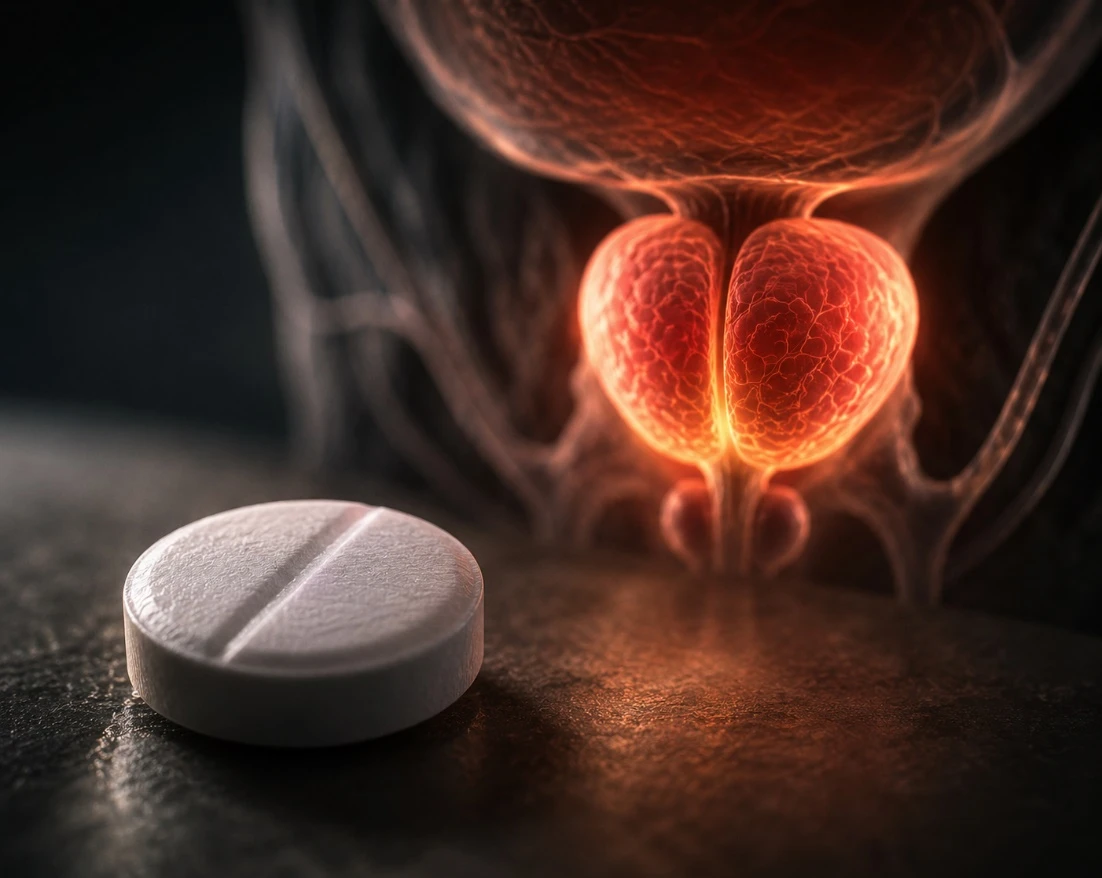
You may have aspirin somewhere in your house.
You take it for your heart or your knees (as it’s not popular to take it for a headache any longer). Or the bottle has sat untouched for years….
Aspirin has been around for more than a century. Well, I can tell you that if aspirin was discovered today, pharmaceuticals would sell it for hundreds of dollars per pill… it provides MANY benefits. I’ll analyze more in future articles.
Now, some researchers asked:
What happens to prostate cancer when a man regularly takes aspirin?
One large analysis of more than 6,500 men produced a striking result.
Aspirin use was associated with a 41% lower risk of prostate cancer death and a 55% lower risk of dying after a prostate cancer diagnosis. The association was strongest among men taking aspirin daily or using it for cardiovascular disease prevention.
Sorry, what? You might wonder why nobody has mentioned that a pill that costs almost nothing, has no side effects, and can complement your treatments can have such a tremendous effect in curing prostate cancer?
Look, these numbers are impressive, but they come from an observational study. They show a connection, but they do not prove that aspirin caused the better outcome.
And that’s why we have meta-analyses.
A 2023 meta-analysis combined data from randomized trials and real-world studies. Across the pooled data, aspirin use was associated with:
A 4% lower chance of developing prostate cancer, and
A 12% lower risk of dying from prostate cancer.
Among men already diagnosed with prostate cancer, aspirin use was also associated with a lower risk of prostate cancer-related death.
But when the researchers separated the randomized controlled trials from the observational studies, the picture changed. The randomized trials did not show a clear prostate-cancer benefit.
These findings were promising, but that study did not show whether aspirin itself is responsible for reducing prostate cancer deaths.
What happened in 2025
A multicenter study followed 6,207 men who underwent robotic surgery to remove the prostate. Among them, 350 men were taking aspirin, while 5,857 were not. Researchers compared the two groups while carefully adjusting for other factors that influence outcomes, ensuring a fair comparison between aspirin users and non-users.
The men taking aspirin had a significantly better chance of staying free from the cancer after surgery, based on monitoring their PSA levels, which can indicate if the cancer has returned.
At three years:
85% of men taking aspirin remained free from prostate cancer recurrence.
74.5% of men not taking aspirin remained free from recurrence.
The difference held up after statistical matching.
Among men with more aggressive forms of prostate cancer, those taking aspirin were less likely to have their cancer return after treatment.
Another study found similar results in men who received radiation therapy after prostate surgery.
Researchers followed 189 men for just over 4 years. Those taking aspirin had a much lower chance of the cancer returning based on PSA blood tests. They were also less likely to have the cancer progress and spread to other parts of the body (metastasis). During the follow-up, no prostate cancer deaths occurred among aspirin users, compared with a small number in men who were not taking aspirin. After accounting for other factors that could affect the results, aspirin use emerged as the strongest independent predictor of a lower risk of cancer recurrence.
So now after all that, it’s fair to pause for a moment and wonder why you haven’t heard about aspirin before….
What aspirin is doing inside the body
Prostate cancer does not grow in isolation. It interacts constantly with inflammation, blood vessels, platelets, and the immune system.
Aspirin reduces inflammation by blocking the production of certain chemicals that trigger inflammatory responses in the body.
Aspirin also makes platelets less sticky. Platelets are best known for clotting blood, but cancer cells interact with platelets directly. Researchers have shown that platelets help circulating cancer cells survive and attach to blood vessel walls. Aspirin disrupts that process.
This gives researchers a biological explanation for why aspirin users show better cancer outcomes in some studies.
Chronic inflammation builds an environment that supports cancer growth and survival. Aspirin reduces certain inflammatory signals, and that changes the environment cancer cells depend on.
These are biological mechanisms under active investigation. They explain a pattern, but they do not prove that aspirin treats prostate cancer.
The biggest mistake you can make
After reading this, some men jump straight to a decision: start taking aspirin today.
Don’t decide that on your own.
Aspirin can irritate the stomach lining and cause serious internal bleeding. In some men, it also interacts badly with other medications.
For some men, the cardiovascular benefits of aspirin outweigh the risk. For others, the bleeding risk outweighs the benefit.
That balance depends on your age, cardiovascular history, current medications, bleeding risk, and treatment plan.
What you should do:
Ask your medical team (including oncologist and GP) if you can take aspirin safely.
Do not start taking aspirin if you are already taking anti-coagulants (blood thinners) as it is a blood thinner itself.
If you get the green light to take it from your medical team, choose low-dose COATED aspirin (sometimes also called baby aspirin). Not the white pill that you’re used to. The coated one is designed to pass through the stomach and dissolve in the intestine, while regular aspirin dissolves in the stomach, so it reduced the risk of stomach bleeding compared to uncoated aspirin.
A daily pill that has sat in medicine cabinets for generations is still giving cancer researchers plenty to investigate. The prostate cancer story on aspirin is far from finished.
If you want evidence-based nutrition and lifestyle strategies for prostate cancer, subscribe to my newsletter for practical weekly guidance. If you want a plan built around your PSA history, treatment, medications, diet, exercise, and individual goals, my 1-to-1 coaching can help you build a strategy specific to your situation.
You can also join my Prostate Cancer Health Coaching Group, where men use exercise, nutrition, and lifestyle as medicine while supporting each other through every stage of the journey.
Other articles you may find interesting

What happened in the brain after three months of tomato paste?
I regularly recommend tomato paste to men with prostate cancer. A new human study gives us something else to talk about.
How prostate cancer rewires itself when testosterone is cut off
A hidden metabolic switch may change how castrate-resistant prostate cancer survives hormone therapy through diet.
What Happens to Prostate Cancer When Tomato Is Added to a Western Diet?
The same food was tested under two dietary conditions. What happened challenges the way we think about “anticancer” foods.
The pill that’s cutting prostate cancer deaths by 41%
New research suggests a widely used medication may reduce the risk of prostate cancer coming back after surgery, especially in aggressive disease.
References
Loomans-Kropp, H. A., Pinsky, P., Cao, Y., Chan, A. T., & Umar, A. (2019). Association of aspirin use with mortality risk among older adult participants in the prostate, lung, colorectal, and ovarian cancer screening trial. JAMA Network Open, 2(12), e1916729.
Loomans-Kropp, H. A., Pinsky, P., & Umar, A. (2021). Evaluation of aspirin use with cancer incidence and survival among older adults in the prostate, lung, colorectal, and ovarian cancer screening trial. JAMA Network Open, 4(1), e2032072.
Ma, S., Xia, W., Wu, B., Sun, C., Jiang, Y., Liu, H., Lowe, S., Zhou, Z., Xie, P., Gao, J., Feng, L., Guo, X., Qu, G., & Sun, Y. (2023). Effect of aspirin on incidence, recurrence, and mortality in prostate cancer patients: integrating evidence from randomized controlled trials and real-world studies. European Journal of Clinical Pharmacology, 79(11), 1475–1503.
Suzuki, S., Negoro, H., Kubota, M., Sumiyoshi, T., Saito, R., Okuno, T., Segawa, T., Fukuzawa, S., Onishi, H., Hattahara, K., Nagahama, K., Sekine, Y., Kurahashi, R., Shimatani, K., Sawada, A., Akamatsu, S., Nishiyama, H., Goto, T., & Kobayashi, T. (2025). Impact of aspirin on biochemical recurrence of prostate cancer after robot assisted radical prostatectomy in a multicenter retrospective cohort study. Scientific Reports, 15(1), 2025.
Joshi, S., Murphy, E., Olaniyi, P., & Bryant, R. (2020). The multiple effects of aspirin in prostate cancer patients. Cancer Treatment and Research Communications, 26, 100267
Zaorsky, N.G., Li, T., Cohen, R.J. et al. Aspirin use decreases the risk of prostate cancer recurrence after post-prostatectomy radiotherapy. J Radiat Oncol 4, 193–201 (2015).