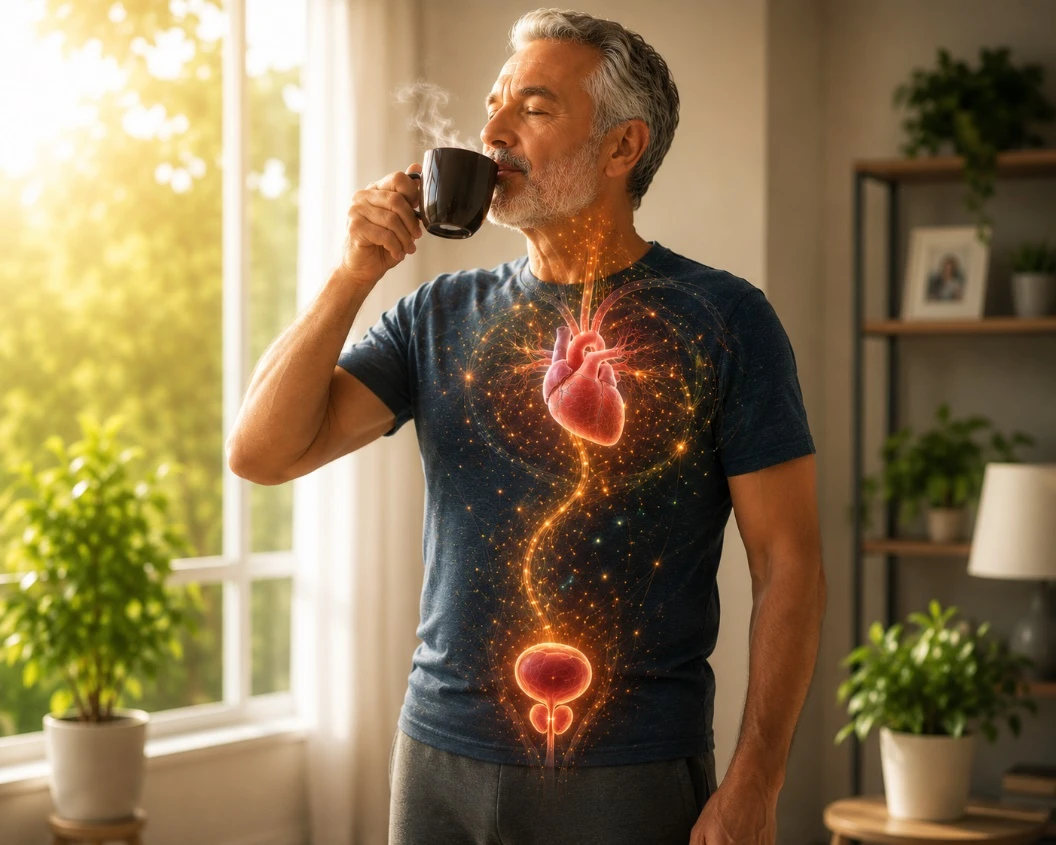
If you have prostate cancer, you have probably been warned about alcohol, processed foods, and sugar.
Coffee gets overlooked.
Most men assume it’s either harmless or a bad habit they should quit… but the research says otherwise.
Study after study keeps finding the same pattern: men who drink more coffee have a lower risk of developing aggressive prostate cancer and a lower risk of dying from it.
What’s the actual evidence?
A large review published in the World Journal of Urology examined diet and lifestyle factors that influence the growth of prostate cancer and a person’s risk of dying from it.
Higher coffee consumption was consistently linked to a lower risk of developing prostate cancer, and the effect was strongest for aggressive forms of the disease.
Men who drank several cups of coffee per day showed:
Lower risk of advanced prostate cancer
Lower risk of recurrence and progression
Lower prostate cancer-specific mortality
The next question is what coffee is actually doing inside the body?
Remember this: coffee is not one drink
Coffee contains hundreds of active compounds. The ones that matter most for prostate health are:
Polyphenols, especially chlorogenic acids
Diterpenes, such as cafestol and kahweol
Actually, caffeine itself has been shown in pre-clinical models to independently inhibit prostate cancer progression
Collectively, these compounds act on inflammation, blood sugar, hormones, and oxidative stress; four factors that drive prostate cancer growth.
Coffee calms inflammation
Prostate cancer thrives in an inflammatory environment. Long-term inflammation damages tissue and helps cancer cells survive and spread.
Coffee is rich in natural plant compounds called polyphenols that act as antioxidants, helping protect your cells from damage and reduce harmful inflammation throughout the body.
Researchers point to this as one of the main reasons coffee shows up as protective across so many prostate cancer studies. Lower inflammation and lower oxidative stress build an environment where cancer struggles to grow.
Coffee improves insulin sensitivity
High insulin levels and insulin resistance are linked to more aggressive prostate cancer. Besides controlling blood sugar, insulin also tells cells to grow. When insulin and the body’s natural growth hormone, IGF-1, are both high, they can speed up cell growth and multiplication.
Coffee consumption is repeatedly associated with better insulin sensitivity and improved glucose regulation. It moves the body away from the exact conditions that fuel tumor growth.
Coffee affects hormone pathways
Researchers have found that coffee affects sex hormone levels and hormone activity in the body. Since prostate cancer is influenced by hormones, even small changes over many years can influence disease development.
But not all coffee is equal
A black filtered coffee and a caramel Frappuccino are different drinks entirely. Black coffee is rich in polyphenols. A Frappuccino is a dessert with coffee flavoring.
Sugar, syrups, whipped cream, and heavy cream add calories that increase inflammation, worsen insulin resistance, and drive up body fat, all of which work against prostate health. Sugary coffee drinks erase the benefit that black coffee provides.
The research supporting prostate cancer protection is about plain black coffee or, at most, lightly sweetened… not milkshakes with a coffee flavor.
The brewing method matters
How you prepare coffee changes what ends up in the cup.
Espresso holds extremely high concentrations of polyphenols and caffeine per milliliter. Cold brew delivers a large total dose simply because the serving size is bigger.
The filter can play an important role
Paper-filtered coffee strips out most of the diterpenes, oily compounds that raise LDL cholesterol when consumed in large amounts. Interestingly, these same diterpenes have also been shown to slow the growth and spread of prostate cancer cells in lab and animal studies. French press, boiled coffee, and unfiltered espresso preparations let those oils pass straight into the cup.
However, at the same time, cardiovascular health matters for men with prostate cancer. Heart disease is one of the leading causes of death in men on androgen deprivation therapy.
So which way should you brew it?
If LDL and cholesterol aren’t a concern for you, cold-brew your coffee with a metallic mesh filter instead of paper. You keep the diterpenes, and with them, their anti-prostate cancer effect. If cholesterol is a concern, stick with a paper filter. You’ll lose most of the diterpenes, but you still get the anti-cancer polyphenols, since those are water-soluble and pass straight through the paper.
Paper-filtered coffee gives you the polyphenols without the cholesterol-raising oils.
The best choice
Based on the current evidence:
Black, paper-filtered coffee offers the best balance of benefits.
Minimal sugar and additives preserve the protective effect.
Moderate to higher coffee consumption (4-6 cups) is linked to a lower risk of prostate cancer and improved survival among people already diagnosed with prostate cancer.
Remember: no single food determines your outcome, and no single drink cures cancer. Prostate cancer responds to the environment surrounding it; inflammation, blood sugar, body composition, and cell damage caused by harmful molecules all shape that environment.
Coffee interacts with several biological processes linked to prostate cancer, including inflammation, blood sugar regulation, hormone activity, and cellular protection.
A daily habit as simple as your coffee can help build an internal environment that works against prostate cancer progression.
Want practical nutrition strategies after a prostate cancer diagnosis? Subscribe to my newsletter for practical weekly guidance. If you want accountability and a community of men doing this together, my Prostate Cancer Health Coaching Group is where to go. If you want a plan built around your PSA history, treatment, diet, and goals, my 1-to-1 coaching builds a strategy tailored specifically to you (and also includes the group).
Other articles you may find interesting
What happened in the brain after three months of tomato paste?
I regularly recommend tomato paste to men with prostate cancer. A new human study gives us something else to talk about.
How prostate cancer rewires itself when testosterone is cut off
A hidden metabolic switch may change how castrate-resistant prostate cancer survives hormone therapy through diet.
What Happens to Prostate Cancer When Tomato Is Added to a Western Diet?
The same food was tested under two dietary conditions. What happened challenges the way we think about “anticancer” foods.
The pill that’s cutting prostate cancer deaths by 41%
New research suggests a widely used medication may reduce the risk of prostate cancer coming back after surgery, especially in aggressive disease.
References
Svatun, Å. L., Løchen, M., Thelle, D. S., & Wilsgaard, T. (2022). Association between espresso coffee and serum total cholesterol: the Tromsø Study 2015–2016. Open Heart, 9(1), e001946.
Orrje, E., Fristedt, R., Rosqvist, F., Landberg, R., & Iggman, D. (2025). Cafestol and kahweol concentrations in workplace machine coffee compared with conventional brewing methods. Nutrition Metabolism and Cardiovascular Diseases, 35(8), 103933.
Peisch, S. F., Van Blarigan, E. L., Chan, J. M., Stampfer, M. J., & Kenfield, S. A. (2016). Prostate cancer progression and mortality: a review of diet and lifestyle factors. World Journal of Urology, 35(6), 867–874.
Angeloni, G., Guerrini, L., Masella, P., Bellumori, M., Daluiso, S., Parenti, A., & Innocenti, M. (2018). What kind of coffee do you drink? An investigation on effects of eight different extraction methods. Food Research International, 116, 1327–1335.
Jee, S. H., He, J., Appel, L. J., Whelton, P. K., Suh, I., & Klag, M. J. (2001). Coffee consumption and serum Lipids: A Meta-Analysis of Randomized Controlled Clinical Trials. American Journal of Epidemiology, 153(4), 353–362.
Iwamoto H, Izumi K, Natsagdorj A, et al. Coffee diterpenes kahweol acetate and cafestol synergistically inhibit the proliferation and migration of prostate cancer cells. Prostate. 2018; 1–12.
Zheng, X., Cui, X. X., Huang, M. T., Liu, Y., Wagner, G. C., Lin, Y., Shih, W. J., Lee, M. J., Yang, C. S., & Conney, A. H. (2012). Inhibition of progression of androgen-dependent prostate LNCaP tumors to androgen independence in SCID mice by oral caffeine and voluntary exercise. Nutrition and cancer, 64(7), 1029–1037.