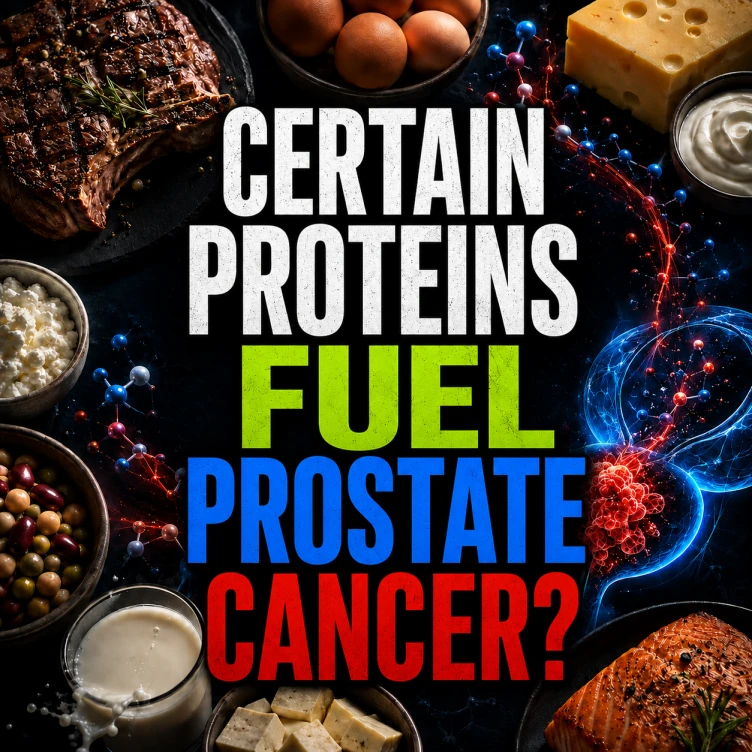
Androgen deprivation therapy (ADT) drives down the androgens prostate cancer uses to grow. Yet castration-resistant prostate cancer (CRPC) can keep the androgen receptor active when blood testosterone is extremely low.
New research points to two components of dietary protein: isoleucine and valine.
What are isoleucine and valine?
Proteins are chains built from smaller units called amino acids. Digestion breaks those chains apart so your body can use the individual pieces.
Isoleucine and valine are essential amino acids. Your body cannot make them, so they must come from food. They belong to a family called branched-chain amino acids (BCAAs).
How could they help prostate cancer?
Researchers found that propionylcarnitine, a marker of a substance called propionyl-CoA, was higher in human prostate tumors than in normal prostate tissue and increased with Gleason grade.
They then tagged nutrients and followed them inside prostate cancer cells. Isoleucine and valine supplied approximately 70% of the cells’ propionyl-CoA.
Propionyl-CoA stabilized sterol regulatory element-binding protein 2 (SREBP2), a switch that increases cholesterol production. Prostate cancer can use cholesterol to manufacture testosterone and dihydrotestosterone (DHT) inside the tumor. These androgens can reactivate the androgen receptor and increase prostate-specific antigen (PSA) production during androgen deprivation.
What happened when researchers restricted them?
Mice carrying C4-2 castration-resistant prostate tumors received a diet containing only 25% of the usual isoleucine and valine for 7 weeks. Other amino acids were increased so protein-derived calories remained equal.
Among 8 to 9 mice per group, the restricted diet markedly suppressed prostate tumor growth and reduced cancer cell division.
Researchers also injected C4-2 prostate cancer cells into the bloodstream of mice. The restricted diet reduced the ability of these prostate cancer cells to colonize the lungs. This was a prostate cancer lung-colonization experiment, not a lung cancer experiment.
This experiment targeted 2 amino acids without lowering total protein.
Which foods contain them?
Virtually every protein food contains isoleucine and valine. Meat, fish, eggs and dairy are concentrated sources. Soy, tofu, beans, peas and lentils contain them too.
Animal sources are usually more concentrated per serving, although plant sources can still provide substantial amounts. Changing the source may lower exposure, but it cannot remove these amino acids.
Protein source may still matter. In another prostate cancer mouse experiment, a diet containing 20% plant protein produced 37% lower castration-resistant prostate tumor weight compared to a diet containing 20% dairy protein. This does not prove that isoleucine and valine caused the difference, but it suggests protein composition matters alongside quantity.
Can these amino acids be lowered in men?
A controlled feeding trial included 38 overweight men with localized prostate cancer. They received either their usual diet or provided meals containing approximately 56 to 60 grams of protein daily for an average of 43 days.
Blood valine fell approximately 19% and isoleucine approximately 9% in the protein-restricted group. Lowering total protein can therefore reduce the two amino acids identified by the new study.
The published analyses did not report whether this slowed tumor growth or changed PSA progression.
Researchers also measured insulin-like growth factor 1 (IGF-1), a hormone that encourages cells to grow and resist cell death. Prostate cancer cells can use IGF-1 to activate growth pathways and strengthen androgen receptor signaling. It provides a biological clue, but cannot prove that a tumor slowed.
The diet did not significantly reduce IGF-1 compared with the control diet.
Does lower total protein slow prostate tumors?
In an earlier experiment, mice carrying castration-resistant LuCaP23.1 human prostate tumors received equal-calorie diets containing 7% vs 21% protein.
The low (7%) protein diet inhibited tumor growth by 70%. Cancer cell division, blood PSA, IGF-1, and mechanistic target of rapamycin complex 1 (mTORC1; another growth pathway) also fell.
Among 621 men with localized prostate cancer, those who reduced protein by approximately 27 grams daily had 6.5% lower IGF-1. That study did not measure tumor growth.
As of August 2026, no published human intervention trial has demonstrated that selectively restricting dietary isoleucine or valine, or deliberately restricting total protein, slows prostate tumor growth, delays recurrence, lengthens prostate-specific antigen doubling time, prevents metastasis, or improves survival.
What this means for you
The biological case is strongest during ADT and CRPC because these tumors may manufacture androgens from cholesterol. Human tumor-outcome evidence is absent for active surveillance, rising PSA after surgery or radiation, and chemotherapy.
There is no proven protein target that can be copied from these mouse diets. Your total intake, protein sources, treatment, weight and disease stage change the calculation.
Inside my private prostate cancer health coaching, I calculate your protein intake, identify the foods supplying most of your isoleucine and valine, and build a precise strategy around your cancer and treatment. You receive specific food quantities, protein targets, substitutions and monitoring points. Apply to work with me if you want this research translated into a plan built specifically for you.
These amino acids are already on your plate. The urgent question is how heavily your protein pattern may be feeding this pathway.
If you want more evidence-based nutrition and lifestyle strategies for prostate cancer, subscribe to my newsletter for practical weekly guidance.
You can also join my prostate cancer health coaching group, where men use exercise, nutrition, and lifestyle as medicine while supporting each other through every stage of the journey.
Other articles you may find interesting
What happened in the brain after three months of tomato paste?
I regularly recommend tomato paste to men with prostate cancer. A new human study gives us something else to talk about.
How prostate cancer rewires itself when testosterone is cut off
A hidden metabolic switch may change how castrate-resistant prostate cancer survives hormone therapy through diet.
What Happens to Prostate Cancer When Tomato Is Added to a Western Diet?
The same food was tested under two dietary conditions. What happened challenges the way we think about “anticancer” foods.
The pill that’s cutting prostate cancer deaths by 41%
New research suggests a widely used medication may reduce the risk of prostate cancer coming back after surgery, especially in aggressive disease.
References
Li, Z., Liu, S., Jin, W., Xiao, L., Kester, O., Bullen, N., Chen, X., Chan, U. I., Owiredu, J., Li, Z., Khan, R., Endress, J., Shafer, M., Low, V., Koundouros, N., Cho, S., Barbieri, C., Guo, C. J., & Blenis, J. (2026). Isoleucine and valine promote prostate cancer progression via propionyl-CoA-mediated cholesterol metabolism. Nature metabolism, 8(8), 1772–1790.
Fontana, L., Adelaiye, R. M., Rastelli, A. L., Miles, K. M., Ciamporcero, E., Longo, V. D., Nguyen, H., Vessella, R., & Pili, R. (2013). Dietary protein restriction inhibits tumor growth in human xenograft models. Oncotarget, 4(12), 2451–2461.
Fontana, L., Cummings, N. E., Arriola Apelo, S. I., Neuman, J. C., Kasza, I., Schmidt, B. A., Cava, E., Spelta, F., Tosti, V., Syed, F. A., Baar, E. L., Veronese, N., Cottrell, S. E., Fenske, R. J., Bertozzi, B., Brar, H. K., Pietka, T., Bullock, A. D., Figenshau, R. S., Andriole, G. L., … Lamming, D. W. (2016). Decreased Consumption of Branched-Chain Amino Acids Improves Metabolic Health. Cell reports, 16(2), 520–530.
Cagigas, M. L., Fiorito, G., Bertozzi, B., Masedunskas, A., Cava, E., Spelta, F., Veronese, N., Tosti, V., Rajakumar, G., Pelaia, T., Bullock, A. D., Figenshau, R. S., Andriole, G. L., & Fontana, L. (2024). Effects of protein restriction on insulin-like growth factor (IGF)-1 in men with prostate cancer: results from a randomized clinical trial. Biomarker research, 12(1), 68.
Er, V., Biernacka, K., Simpkin, A. J., Martin, R. M., Jeffreys, M., Emmett, P., Gilbert, R., Avery, K. N. L., Walsh, E., Davis, M., Donovan, J. L., Neal, D. E., Hamdy, F. C., Holly, J. M. P., & Lane, J. A. (2017). Post-diagnosis serum insulin-like growth factors in relation to dietary and lifestyle changes in the Prostate testing for cancer and Treatment (ProtecT) trial. Cancer causes & control : CCC, 28(8), 877–888.
Culig, Z., Hobisch, A., Cronauer, M. V., Radmayr, C., Trapman, J., Hittmair, A., Bartsch, G., & Klocker, H. (1994). Androgen receptor activation in prostatic tumor cell lines by insulin-like growth factor-I, keratinocyte growth factor, and epidermal growth factor. Cancer research, 54(20), 5474–5478.
Gorissen, S. H. M., Crombag, J. J. R., Senden, J. M. G., Waterval, W. A. H., Bierau, J., Verdijk, L. B., & van Loon, L. J. C. (2018). Protein content and amino acid composition of commercially available plant-based protein isolates. Amino acids, 50(12), 1685–1695.