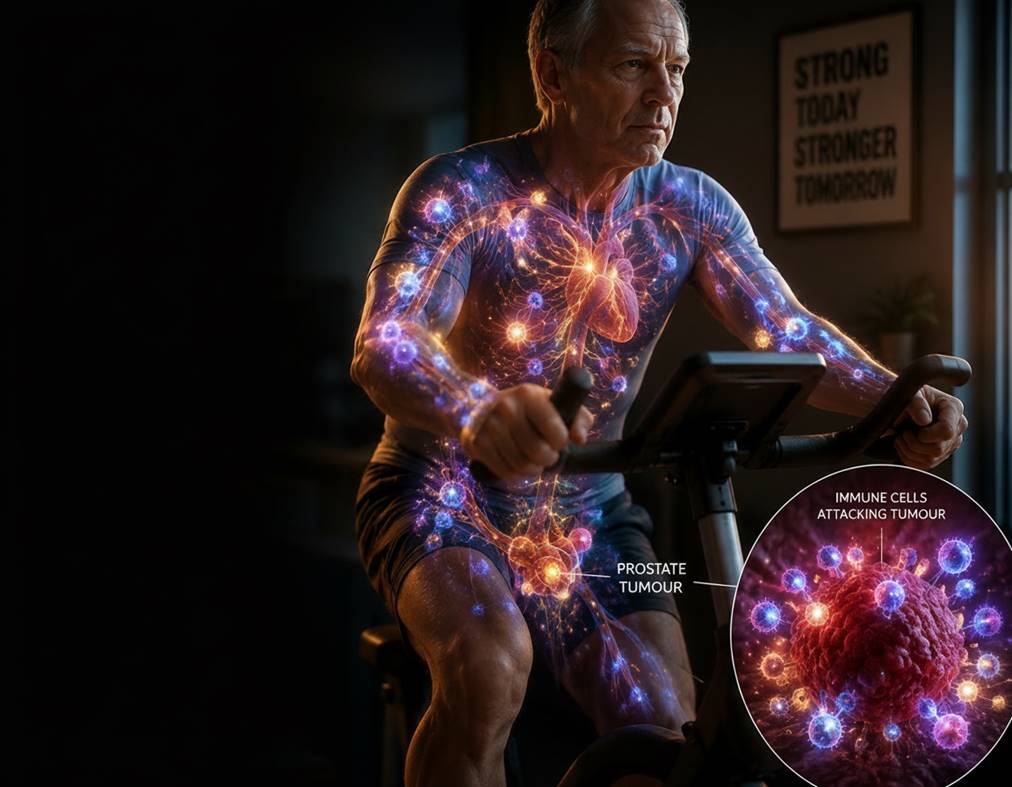
Many men with prostate cancer are already putting in the work. Cleaning up their diet. Walking more. Monitoring their PSA. Doing everything they have been told to do.
But here is what nobody is telling you about exercise.
It is not about your heart, and it is not about your weight. Researchers just discovered that exercise is doing something directly inside the prostate tumor itself, something that changes the whole point about why men with prostate cancer need to move AND exercise.
And the evidence is hard to ignore.
Inside your immune system lives a special type of cell called a Natural Killer cell (NK cell). Their job is to patrol your body to find abnormal cells and destroy them, cancer cells included.
The problem is that most prostate tumors are very good at keeping these cells out.
Researchers wanted to know if exercise could change that.
What the researchers did
30 men with localised prostate cancer, all scheduled for prostate removal surgery, were split into two groups.
One group carried on as normal.
The other group completed high-intensity interval training four times a week, right up until surgery.
Researchers then examined the prostate tissue before and after the exercise period and counted exactly how many NK cells had infiltrated the tumor.
What they found
Here is where it gets interesting.
When researchers looked at the groups as a whole, the difference was not statistically significant. Easy to stop reading there.
But they noticed something.
Not every man exercised the same amount. Some completed just 4 sessions. Others completed close to 30.
And that changed everything.
The men who showed up consistently had significantly more NK cells inside their tumors.
Not slightly more. Significantly more.
The total number of training sessions was directly linked to NK-cell infiltration inside the tumor tissue.
More exercise sessions = more cancer-fighting immune cells getting in.
The men who showed up more got more. It is that simple.
Why this matters for your prostate
Prostate cancer does not exist in isolation.
It exists inside a biological environment. And that environment determines how aggressively the cancer behaves, how well treatments work, and what happens next.
Tumors surrounded by more immune cells are harder places for cancer to survive.
Studies across multiple cancers have shown this clearly. The more immune cells inside a tumor, the worse it is for the cancer and the better it is for you.
Exercise shifts that balance directly inside the prostate tumor itself.
That is not a general health benefit. Something is happening directly inside the tumor. Not around it. Not near it. Inside it.
The exact exercise that did it
The researchers used High-Intensity Interval Training- HIIT.
Short bursts of hard effort followed by recovery. On a stationary bike. Four times a week.
One minute hard. Three minutes easier. Repeated four to six times. Sessions ran twenty to twenty-five minutes of actual work after a warm-up.
Challenging, but short.
And the men who completed more of those sessions were the ones whose tumors showed the greatest change.
The real takeaway
Fitness aside, what these researchers were actually tracking was happening directly inside the tumor, in the tissue itself, in the cells, and in the environment where the cancer lives.
Every session sends signals through your body. Signals that mobilise NK cells. Signals that drive those cells into the tumor tissue. Signals that make the environment inside your prostate cancer harder to live in.
And the signal gets stronger every time you show up.
You cannot control your genetics, and you cannot undo the diagnosis. But you can control how often you exercise.
Remember that consistency is not about building fitness. According to this research, it is turning your own immune system into a weapon against your cancer. It’s a therapy.
The only question is how often you show up.
And you do not have to figure this out alone. For free evidence-based strategies, subscribe to my newsletter. To get structure, support, and community, join my Prostate Cancer Health Coaching Group. Or if you want a plan built specifically around your situation and deeper work, my 1-to-1 coaching is the place to start.
Other articles you may find interesting
What happened in the brain after three months of tomato paste?
I regularly recommend tomato paste to men with prostate cancer. A new human study gives us something else to talk about.
How prostate cancer rewires itself when testosterone is cut off
A hidden metabolic switch may change how castrate-resistant prostate cancer survives hormone therapy through diet.
What Happens to Prostate Cancer When Tomato Is Added to a Western Diet?
The same food was tested under two dietary conditions. What happened challenges the way we think about “anticancer” foods.
The pill that’s cutting prostate cancer deaths by 41%
New research suggests a widely used medication may reduce the risk of prostate cancer coming back after surgery, especially in aggressive disease.
References
Djurhuus, S. S., Simonsen, C., Toft, B. G., Thomsen, S. N., Wielsøe, S., Røder, M. A., Hasselager, T., Østergren, P. B., Jakobsen, H., Pedersen, B. K., Hojman, P., Brasso, K., & Christensen, J. F. (2022). Exercise training to increase tumour natural killer‐cell infiltration in men with localised prostate cancer: a randomised controlled trial. British Journal of Urology, 131(1), 116–124.
Hanson, E. D., Sakkal, S., Que, S., Cho, E., Spielmann, G., Kadife, E., Violet, J. A., Battaglini, C. L., Stoner, L., Bartlett, D. B., McConell, G. K., & Hayes, A. (2020). Natural killer cell mobilization and egress following acute exercise in men with prostate cancer. Experimental Physiology, 105(9), 1524–1539.
Schenk, A., Esser, T., Belen, S., Gunasekara, N., Joisten, N., Winker, M. T., Weike, L., Bloch, W., Heidenreich, A., Herden, J., Löser, H., Oganesian, S., Theurich, S., Watzl, C., & Zimmer, P. (2022). Distinct distribution patterns of exercise-induced natural killer cell mobilization into the circulation and tumor tissue of patients with prostate cancer. American Journal of Physiology-Cell Physiology, 323(3), C879–C884.